"Almond Blossom"
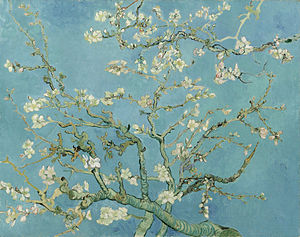
"The last canvas of branches in blossom-yo will se that it is perhaps the bets, the most patiently worked thing i had done, painted
with calm and with greater firmness of touch. And the next day, down ike a brute." Poised between lucidity and desperation, this lace-
workof light and color is kept aloft by the confidence Van Gogh had acquired in the previous two or three years and the sheer technical
finesse now at his command. This painting was deeply influenced by his admiration for Japanese art. In 1888 Vincent wrote to Theo "About
this staying on in the South, even if it is more expensive, consider: we like Japanese painting, we have felt its influence, all the imprresionist
have that in common; then why not go to Japan, that is to say to the equivalent of Japan, the South?"
In the painting, Van Gogh was not out to revive his own optimism, but to make an offering to his ever-caring brother. In spring 1889
Theo had married Joanna Bonger, and in February 1890 she gave birth to their son, whom they named Vincent after the boy's godfather. The
Blossoming Almond Tree was van Gogh's present to the infant that would perpetuate his name. Never before had he viewed the bright buds
in such close-up; never before had he lavishes such color on the glorious blossoms. The hope expressed in the painting is bound up with
human life and thoughts of the future. It is not exactly Utopian in character, rather, the keynote of the painting is longing. And it is
not really a reminiscence of Aries at all- in a sense, the painting is a celebration of family life, which Vincent the godfather now felt
part of it again. In the picture he tried to call forth for his godson what was denied to him: carefree, happy future. "My dear brother,
later one ocassionally finds its necessary to remember", he wrote rather inscritably in a letter when Theo married. Now, painting this picture
, van Gogh's own remembering looked back to his origin, and the family again became the epitome of security on earth, with the birth of a boy who bore his name.
(1)The 1890 painting, "Almond Blosom" was Van Gogh's gift to his newly born nephew and namesake.(2) "Almond Blossom" was part
of a recent "Van Gogh and Japan" joint exhibition of his own works and Japanese paintings.(3)After Vincent's and Theo's death
the painting went to Theo's widow, Joanna Van Gogh Bonger, and then to V.J. Van Gogh. The Van Gogh Foundation acquird the canvas in
1960, and now it resides at the Van Gogh Museum in Amsterdam.(4) Ironically the artist completed his final painting of the
blossoming tree, an image of rebirth and new life, a few short months before his death by suicide.